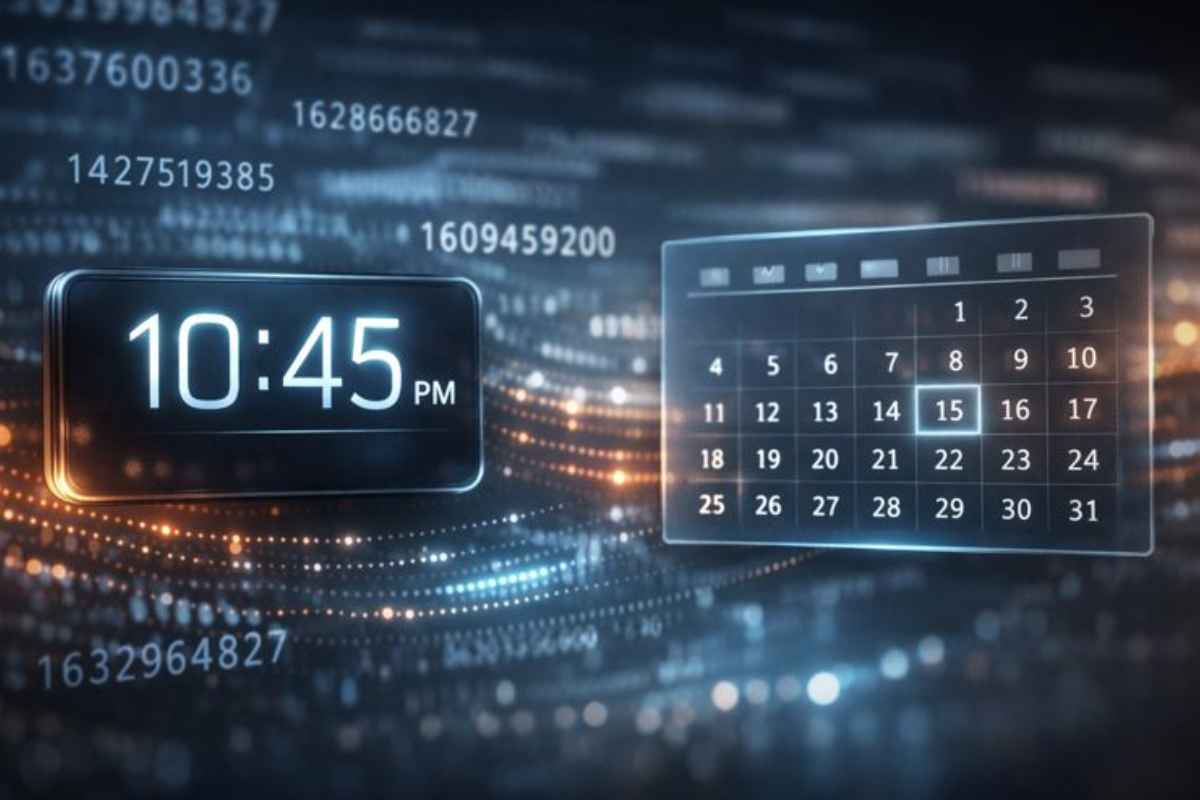
Time runs underneath every game, app, and server you use. Quietly. Constantly. Every save file, login, and crash report carries a number that marks when it happened. That number is usually a Unix timestamp. It looks strange at first. Just a long string of digits. Yet it represents a real moment that has already passed.
At its simplest, Unix time is a count of seconds. The count started on January 1, 1970, at midnight UTC. From that point forward, each passing second adds one to the total. Computers love this format because it avoids confusion. Humans need it translated.
This article explains what Unix timestamps are, why they exist, and how they turn into dates you can actually understand. No jargon. No stiff tone. Just clear explanations that make the numbers feel familiar.
What Unix Time Measures
Unix time measures one thing only. Seconds passed since the Unix epoch. The epoch is January 1, 1970, at 00:00:00 UTC.
A timestamp of 0 means the exact starting moment. A timestamp of 60 means one minute later. A timestamp in the billions means many decades have passed.
There are no months or weekdays inside the number. Those details come later when the number is converted.
Why This System Was Chosen
Early computer systems needed a shared sense of time. Storing dates as text caused problems. Formats differed. Local clocks drifted.
Counting seconds solved those issues. One number worked everywhere. It sorted cleanly. It compared easily.
That decision still pays off today. Unix time avoids ambiguity.
Why Unix Timestamps Feel Unfriendly
People think in calendars. Days. Hours. Events. A number like 1704067200 does not trigger memory.
That number actually represents January 1, 2024. Without conversion, that meaning stays hidden.
Turning timestamps into readable dates connects machine records to human understanding.
How Conversion Works
Conversion adds the timestamp seconds to the epoch. Software then calculates years, months, and days.
Leap years and month lengths are handled automatically. You rarely do this by hand.
- Start on January 1, 1970 UTC
- Add the timestamp seconds
- Adjust for leap years
- Apply a time zone for display
Seconds and Milliseconds Matter
One common mistake involves units. Some systems use seconds. Others use milliseconds.
JavaScript usually uses milliseconds. That makes timestamps look much larger.
| Type | Value | Readable Date |
|---|---|---|
| Seconds | 1704067200 | Jan 1 2024 |
| Milliseconds | 1704067200000 | Same moment |
If a date lands centuries ahead, the units were likely mixed.
Time Zones Do Not Change the Timestamp
Unix timestamps are always based on UTC. They never adjust themselves.
Time zones only affect how the date appears on screen.
This keeps stored data consistent across regions.
Why Games Depend on Unix Time
Games rely on accurate timing. Cooldowns. Events. The match starts. Saves.
Using local clocks invites abuse. Players could change the system time.
Server-based timestamps prevent that.
Where You Will See Unix Timestamps
- Game server logs
- Save file metadata
- Patch deployment times
- Achievement records
- Error reports
Simple Tools Make Conversion Easy
Most programming languages include date libraries. Operating systems offer command-line tools.
Online converters help with quick checks while testing or writing.
Always confirm the expected unit before converting.
The 2038 Problem in Brief
Older systems stored Unix time in 32-bit integers.
That format overflows in January 2038.
Modern systems use 64 bit storage to avoid this issue.
Why This Knowledge Sticks Around
Unix time has lasted because it stays simple. It does not assume calendars or cultures.
Understanding it helps track bugs, interpret logs, and verify game events.
Once you learn it, those long numbers stop feeling mysterious.
Reading the Clock Behind the Numbers
Unix timestamps are not cold or abstract. They quietly mark moments you experienced.
Converting them turns raw data back into memory.
That is why learning this small skill pays off again and again.
Leave a Reply