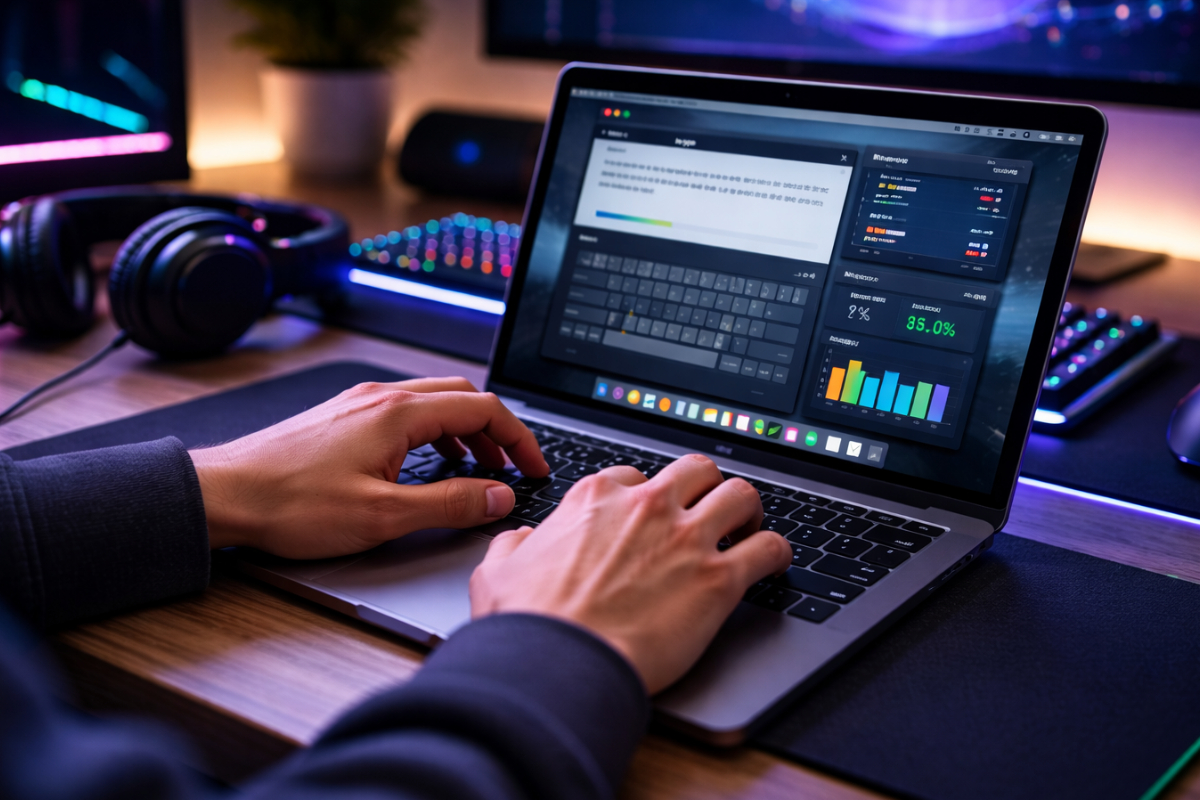
Ranked matches on Mac do not wait for you to settle in. The moment the loading screen fades, you are expected to perform. Your fingers must respond without hesitation. Your key presses must be deliberate and clean. A single mistimed ability, a delayed heal, or an accidental inventory open can shift early momentum. Many players fine-tune graphics, close background apps, and check ping before queuing. Almost none prepare their hands with the same seriousness.
A short 30-seconds typing test acts as a mechanical ignition. In half a minute, you shift from passive posture to active control. The drill exposes stiff finger movement, inconsistent rhythm, and awkward transitions between keys. You immediately feel whether your number row is responsive or sluggish. That awareness alone changes how you enter a match. Instead of warming up during the first fight, you arrive ready.
Ranked Warm Up Overview
- Activate motor memory before high-pressure gameplay.
- Identify weak keys that cause misfires.
- Reinforce number row and modifier consistency.
- Prioritize accuracy before chasing speed.
- Reduce early-game mechanical instability.
Mechanical Readiness Is Competitive Discipline
Competitive Mac gamers already understand preparation. You adjust resolution scaling. You monitor thermal performance. You check for system updates. The same mindset should apply to input stability. In titles such as those discussed in our Dota 2 review, rapid ability combinations define success in critical moments. During a team fight, you may press four to six keys within two seconds. Any hesitation can interrupt a chain that your entire strategy depends on.
Mechanical discipline means reducing variability. Cold hands increase variability. Fingers hover uncertainly. Key travel feels longer. Transitions between keys feel slightly delayed. None of these issues is dramatic on its own, yet ranked matches amplify small inefficiencies. When you stack several minor input delays, the cumulative effect becomes visible in performance.
A typing warm-up narrows that variability. It establishes rhythm. It stabilizes coordination between the left and right hands. It reinforces spatial awareness of the keyboard without visual checking. Once that stability is in place, strategic thinking can occupy more mental space.
From Short Burst to Accuracy Benchmark
The thirty-second drill activates speed. The next step refines precision. Extending your preparation with an online typing test provides a clearer accuracy benchmark. A full minute gives you measurable feedback. Instead of guessing whether you feel ready, you see your error percentage and words per minute in concrete numbers.
Accuracy percentage matters more than raw speed in competitive play. A ninety-nine percent accuracy rate means fewer corrective keystrokes. In-game, fewer corrections translate into cleaner ability execution. That difference becomes noticeable in long sessions.
Strategy-heavy titles demonstrate this clearly. In complex RPGs like those explored in our Baldur’s Gate 3 review, layered hotkeys, inventory shortcuts, and dialogue navigation require consistent finger placement. A single misplaced press may open the wrong menu or interrupt the flow. Accuracy creates continuity. Continuity supports immersion and tactical clarity.
Motor repetition gradually reduces conscious effort. Research cataloged by the U.S. National Library of Medicine explains how practiced sequences become automatic, lowering the cognitive load required for execution. Ranked matches are cognitively demanding environments. You track cooldown timers, monitor enemy movement, manage resources, and communicate with teammates. When keyboard input becomes automatic, your mental bandwidth shifts toward strategy rather than mechanics.
Cold Start Versus Warm Start Performance
Entering ranked play without warming up often results in a cold start. The first match feels awkward. You may miss simple commands. You may hesitate before activating core abilities. That initial instability can influence confidence for the remainder of the session.
With a warm start, the first engagement feels controlled. Fingers respond without conscious correction. The rhythm of movement and ability usage feels smoother. That early confidence often carries forward into decision-making. Players who feel mechanically steady are more willing to take calculated risks and coordinate assertively with teammates.
Consider high-intensity action games where reaction windows are narrow. A warmed-up player maintains cleaner inputs during surprise encounters. A cold player may panic and press multiple keys simultaneously. Preparation reduces that panic response.
Structured Two- to Five-Minute Routine
Keep the routine simple and repeatable. The goal is activation, not exhaustion.
- Run a thirty-second timed drill focusing on steady rhythm rather than maximum speed. Concentrate on even key pressure and controlled breathing.
- Repeat the drill and aim to improve accuracy by at least one percent. Small gains reinforce discipline.
- Perform rapid number row bursts if your main game relies heavily on ability keys bound to numbers.
- Cycle common modifier combinations such as shift plus ability or control plus item activation.
- Finish with a brief relaxation pause. Shake out tension and ensure wrists feel neutral before entering the queue.
This structure activates neural pathways linked to fine motor control. It also ensures that the most frequently used keys receive focused repetition before high-pressure scenarios.
Accuracy Before Speed
Speed attracts attention because it is easy to measure and compare. Competitive performance values reliability more than raw pace. An incorrect ability activation during a critical engagement carries far more consequences than slightly slower typing.
Accuracy builds trust in your own inputs. When you trust your keystrokes, you reduce hesitation. Reduced hesitation lowers stress. Lower stress improves reaction clarity and communication quality. That chain reaction begins with disciplined mechanical preparation.
Speed will naturally increase as consistency stabilizes. Forcing speed prematurely often increases error rate and undermines the goal of preparation.
Preparation Impact Table
| Preparation Level | Input Consistency | Mental Load | Early Match Confidence |
|---|---|---|---|
| No Warm-Up | Variable | Higher | Uncertain |
| Short Activation | Improved | Moderate | Stable |
| Full Routine | High | Lower | Confident |
Weekly Drill Rotation For Adaptability
- Thirty-second burst emphasizing rhythm control.
- Sixty-second accuracy run with minimal corrections.
- Rapid number row cycling drills.
- Modifier-focused sequences using shift and control.
- Blind typing of common team chat callouts.
Rotating drills improves adaptability across genres. Strategy titles stress wide keyboard coverage. Action games emphasize rapid repetition of specific keys. MMORPGs require sustained modifier coordination. Exposure to different patterns strengthens overall dexterity.
Compounding Gains Over Time
Two minutes before each ranked session may seem minor. Across thirty sessions, that equals an hour of targeted motor refinement. Over months, the accumulated repetition meaningfully strengthens automaticity.
As automaticity increases, mechanical corrections decrease. Fewer corrections preserve cognitive energy. Preserved cognitive energy supports better tactical awareness and faster strategic evaluation. That relationship between mechanics and strategy becomes more apparent as sessions lengthen.
Mechanical preparation also supports emotional control. Players who feel physically ready experience fewer frustration spikes. Reduced frustration keeps communication clear and cooperative.
Enter Ranked With Control
Ranked gaming tests awareness, timing, and composure. Keyboard stability underpins all three. A brief typing warm up strengthens the physical foundation beneath competitive decision-making. Clean keystrokes reduce avoidable mistakes. Reduced mistakes protect momentum.
Before pressing the queue, activate your hands. Confirm your accuracy. Establish rhythm. Arrive at your first engagement already in control rather than adjusting mid-fight. Small, consistent rituals often produce the most dependable improvements in competitive play.
Leave a Reply